Overview of the public health assessment process
Purpose and scope
This website outlines the steps and procedures in the public health assessment process for investigation of concerns about the health effects of exposure to environmental toxins in residential and community settings; it does not apply to investigations of occupational exposures.
A public health assessment is conducted to determine whether and to what extent people have been, are being, or may be exposed to hazardous substances and, if so, whether that exposure is harmful and should be mitigated or reduced. A public health assessment is formally defined as:
The evaluation of data and information on the release of hazardous substances into the environment in order to assess any [past], current, or future impact on public health, develop health advisories or other recommendations, and identify studies or actions needed to evaluate and mitigate or prevent human health effects (42 Code of Federal Regulations, Part 90, published in 55 Federal Register 5136, February 13, 1990).
Response objectives
The assessment and response to public health concerns about exposures to environmental contaminants in a community involves one or more of the following objectives.
Determine whether:
- The contaminant of concern is known or suspected to cause adverse health effects
- The contaminant is present in the environment at levels that could harm public health
- A route of exposure exits
- People have been exposed to the contaminant at levels that could harm health
- The adverse effect is clinically apparent in people known to be exposed
The flowchart to the right illustrates these objectives in terms of questions that need to be answered, and the type of public health investigation conducted, to determine where an environmental contaminant could produce an adverse effect.
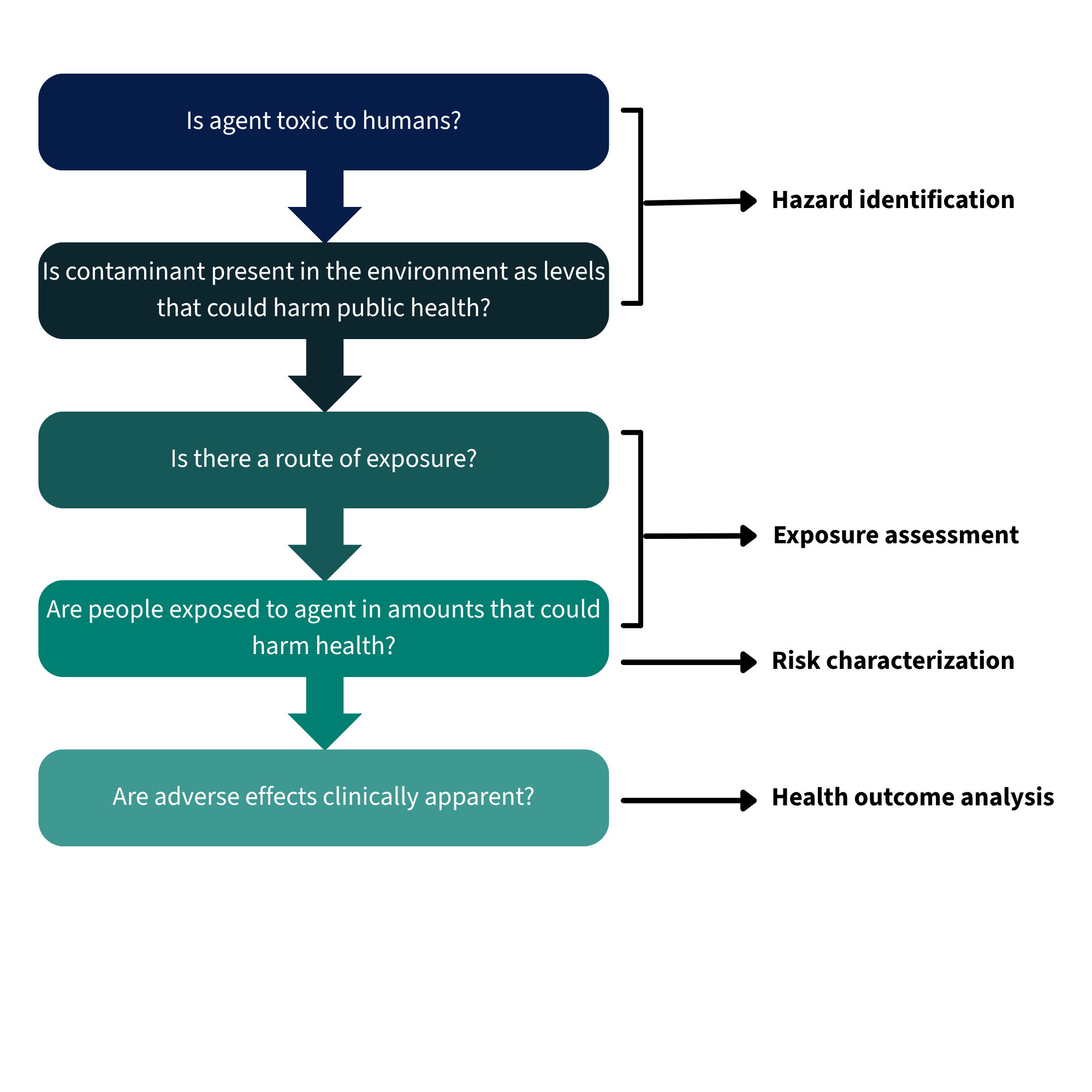
Environmental Epidemiology Program health assessment process
This section describes when and how the Environmental Epidemiology Program (EEP) conducts a public health assessment. Utah maintains a cooperative agreement with the Agency for Toxic Substances and Disease Registry (ATSDR), a federal public health agency. Through ATSDR’s Partnership to Promote Localized Efforts to Reduce Environmental Exposure, known as APPLETREE, the Environmental Epidemiology Program receives federal funding to provide health-based risk assessments and public health education following ATSDR’s guidance documents and procedures.
Two situations can trigger a public health assessment:
- EEP receives a petition from concerned citizens to evaluate a site or release.
- EEP receives a request from a state agency, local health department, local municipality, or tribe.
The public health assessment process involves multiple steps, but consists of two primary technical components—the exposure evaluation and the health effects evaluation. These two components lead to conclusions and recommendations and identification of specific and appropriate public health actions to prevent harmful exposures. The following figure outlines the specific steps in the public health assessment process used by EEP as part of the states’ cooperative agreement with ATSDR.
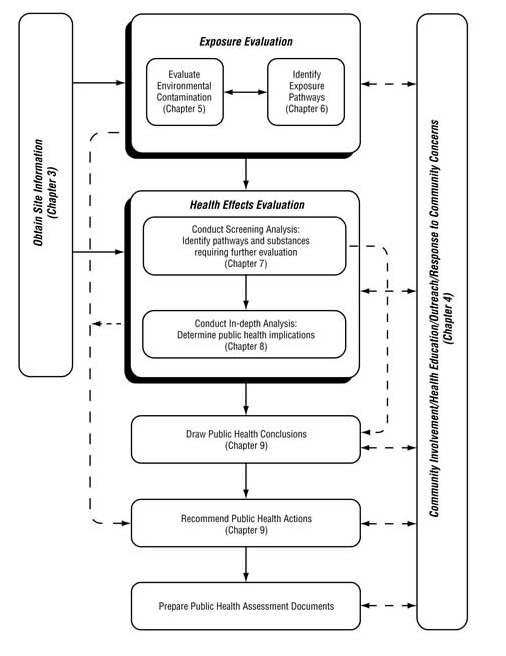
Partnerships
EEP’s overall process requires close coordination and communication with federal, state, and local agencies including the U.S. Environmental Protection Agency (EPA), ATSDR, Utah Department of Environmental Quality (UDEQ), and local health departments (LHDs). EEP relies on partner agencies, including EPA and UDEQ, to collect and provide environmental sampling data. EEP then evaluates and interprets the results of environmental sampling provided by UDEQ or EPA. EEP also advises partner agencies on sampling plans to ensure data are collected from the right locations and the right environmental media (air, water, soil, etc.), and that samples are tested for the relevant contaminants of concern for public health evaluation.
| Response objective | Activities | Responsible party |
|---|---|---|
| Is the agent of concern known or suspected to cause adverse health effects? | Review research literature Consult with appropriate subject matter experts (i.e., ATSDR, EPA, RACC) | DHHS EEP |
| Is the agent of concern present in the environment at levels that could harm public health? | Environmental sampling | UDEQ US EPA |
| Is the agent of concern present in the environment at levels that could harm public health? | Comparison of environmental data to health-based screening levels | DHHS EEP |
| Is there a route of exposure? | Identify types of exposure(s): dermal, ingestion, inhalation Identify completed, potential, and eliminated exposure pathways | DHHS EEP |
| Are people exposed to the agent in amounts that could harm health? | Determine exposure scenario (duration of exposures) | DHHS EEP UPHL |
| Are people exposed to the agent in amounts that could harm health | Analyze measurements of contaminants in blood or urine in exposed communities* | UPHL |
| Are adverse effects clinically apparent? | Analysis of health outcome data (e.g., cancer, birth anomalies) Case finding | DHHS epidemiologists |
| Community Outreach and Education | Communicate findings and recommendations to communities | DHHS EEP LHDs |
DHHS: Utah Department of Health and Human Services
UDEQ: Utah Department of Environmental Quality
ATSDR: Agency for Toxic Substances and Disease Registry
EPA: Environmental Protection Agency
RACC: Risk Assessment Coordination Committee
UPHL: Utah Public Health Lab
*EEP rarely collects blood or urine samples. However, they may evaluate sample results generated by other partners or parties. EEP works closely with partners at the Chemical Threats Laboratory at the Utah Public Health Lab (UPHL), a state branch of CDC’s Laboratory Response Network. The Chemical Threats Laboratory operates under the Public Health Emergency Preparedness grant and is a 24/7/365 resource for collection and analysis of clinical samples for the presence of certain environmental toxins and chemicals of warfare.